
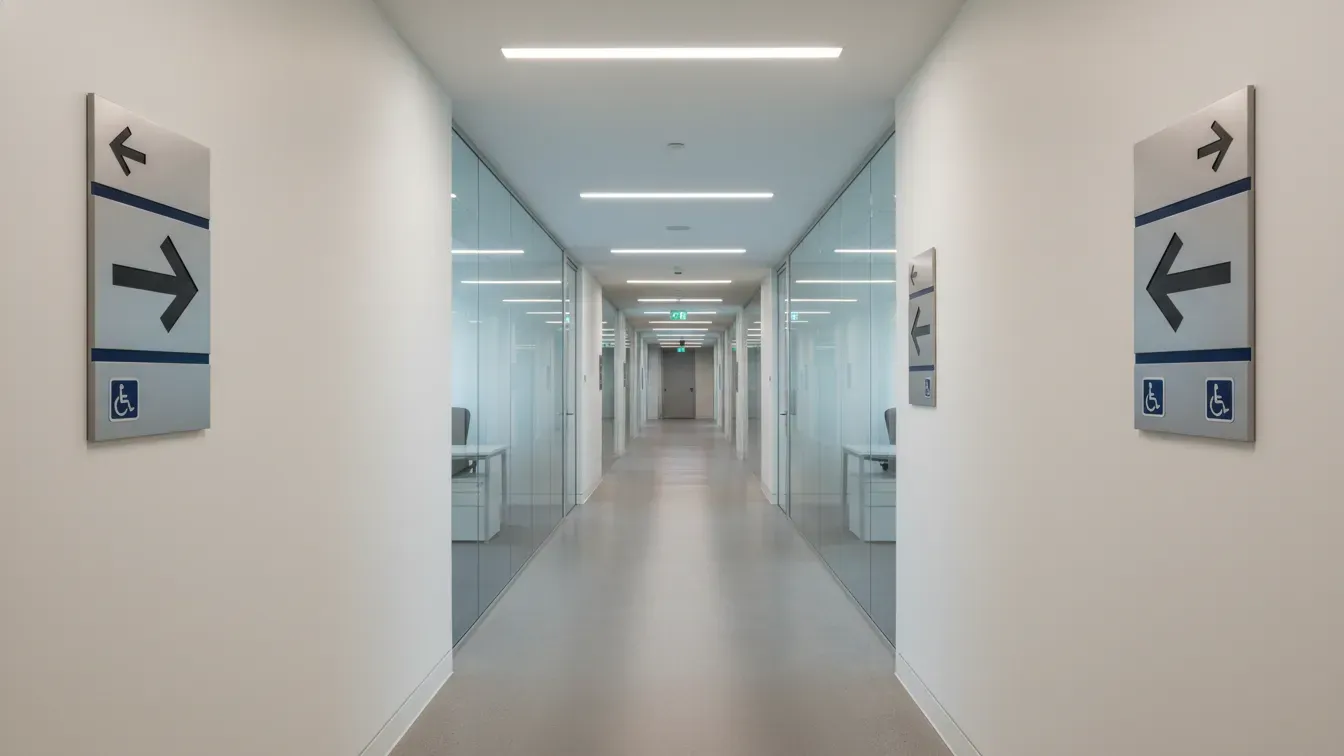
Navigating ADA compliance for wayfinding signage can feel overwhelming. Between contrast ratios, tactile character requirements, Braille specifications, and mounting heights, it is easy to miss a critical detail that leads to costly corrections or, worse, a complaint. For facility managers, property owners, and brand directors working with commercial spaces, understanding ADA compliant wayfinding signage requirements is not optional.
Contact AP Installations or call (503) 924-6168 for expert guidance on ADA-compliant signage and vinyl graphics installation for your commercial facility.
This guide breaks down ADA wayfinding signage requirements in plain language, covering everything from character sizing to floor marking standards. You will also learn how vinyl graphics complement ADA-compliant signage programs in corporate offices, hospitals, retail environments, and public facilities.
What Is ADA-Compliant Wayfinding Signage?
ADA-compliant wayfinding signage refers to directional and informational signs within buildings and facilities that meet the standards set by the Americans with Disabilities Act (ADA). These standards, codified in the 2010 ADA Standards for Accessible Design (Section 703), ensure that people with visual impairments, mobility limitations, and other disabilities can navigate spaces independently and safely.
Wayfinding signage includes room identification signs, directional signs, informational displays, exit signs, and floor-level markers. ADA compliance requires specific design elements such as tactile characters, Braille, high-contrast color combinations, non-glare finishes, and precise mounting locations.
Businesses that fail to meet these standards face legal liability under federal law, potential lawsuits, and fines. But compliance is also good business practice. A facility that is easy to navigate creates a better experience for every visitor, including employees, customers, and emergency responders.
Key ADA Signage Requirements for Commercial Facilities
ADA signage standards apply to all commercial facilities open to the public, including offices, hospitals, retail stores, hotels, educational institutions, and government buildings. Here are the core requirements every business needs to understand.
Tactile Characters and Braille
Signs that identify permanent rooms and spaces (such as restrooms, stairwells, and exit doors) must include raised tactile characters and Grade 2 Braille. These tactile elements allow people with visual impairments to read signs by touch.
- Character height: Tactile characters must be between 5/8 inch and 2 inches, depending on the height of the character above the floor
- Character depth: Raised characters must project at least 1/32 inch from the sign surface
- Braille placement: Grade 2 Braille must be placed directly below the corresponding tactile text, with specific spacing requirements
- Font style: Tactile characters must use sans-serif fonts without italic, oblique, script, or decorative styling
Directional and informational signs (those that do not identify permanent rooms) are not required to include tactile characters or Braille. However, they must still meet visual accessibility standards for character height, contrast, and finish.
Contrast Ratios and Non-Glare Finishes
All ADA-compliant signs must feature high contrast between characters and their background. The ADA standards specify that characters must contrast with their background using either light characters on a dark background or dark characters on a light background. While the ADA does not prescribe a specific numeric contrast ratio, the general guideline is to aim for at least a 70% contrast ratio between text and background.
- Non-glare finish: Both characters and background must have a non-glare (matte) finish to reduce reflections that make signs harder to read
- Color selection: High-contrast combinations such as white on dark blue, black on white, or cream on dark brown are common choices
- Avoid patterns: Backgrounds should be solid colors without patterns, gradients, or textures that reduce legibility
For businesses considering vinyl wall graphics as part of their signage program, selecting the right material finish is critical. Matte-finish vinyl films meet the non-glare requirement while providing the durability needed in high-traffic commercial spaces.
Mounting Height and Location
Proper sign placement is just as important as sign design. The ADA specifies precise mounting requirements for tactile signs.
- Height range: Tactile characters must be mounted between 48 inches and 60 inches above the finished floor, measured from the baseline of the lowest character to the baseline of the highest character
- Door-adjacent placement: Signs identifying rooms must be mounted on the latch side of the door. For double doors, the sign goes on the nearest adjacent wall to the right
- Approach clearance: A person must be able to approach within 3 inches of the sign without encountering obstructions, so they can touch and read tactile characters
- Visual signs above 80 inches: Overhead directional signs and banners may be mounted higher but must meet larger minimum character height requirements based on viewing distance
Visual Character Sizing
Character height requirements for visual (non-tactile) signs depend on the sign’s mounting height and the expected viewing distance.
| Mounting Height | Viewing Distance | Minimum Character Height |
|---|---|---|
| 40 to 70 inches above floor | Less than 72 inches | 5/8 inch |
| 40 to 70 inches above floor | 72 inches or more | 5/8 inch plus 1/8 inch per foot beyond 72 inches |
| 70 to 120 inches above floor | Less than 180 inches | 2 inches |
| 70 to 120 inches above floor | 180 inches or more | 2 inches plus 1/8 inch per foot beyond 180 inches |
| Above 120 inches | Less than 21 feet | 3 inches |
| Above 120 inches | 21 feet or more | 3 inches plus 1/8 inch per foot beyond 21 feet |
These size requirements ensure that overhead directional signage, hallway markers, and lobby directories remain legible at the distances from which people typically read them.
How Do Floor Markings Fit into ADA Wayfinding?
Floor markings play an increasingly important role in ADA-compliant wayfinding programs. While the ADA Standards for Accessible Design do not include specific requirements for floor-based directional graphics, floor markings serve a complementary function that enhances overall wayfinding accessibility.
Floor decals and graphics help guide visitors through complex facilities by reinforcing the directional information provided by wall-mounted signs. They are especially valuable in the following settings:
- Hospitals and medical centers: Color-coded floor paths help patients and visitors navigate between departments without relying solely on overhead or wall signage
- Retail environments: Directional floor graphics guide customers to checkout areas, exits, and key departments
- Corporate offices: Floor markers at intersections and elevator lobbies supplement wall-mounted room signs
- Public buildings: Municipal facilities and transit hubs use floor wayfinding to manage high foot traffic efficiently
When specifying floor graphics for concrete or hard surfaces, choose materials with anti-slip coatings that meet ADA requirements for ground surfaces. The Americans with Disabilities Act requires that floor surfaces along accessible routes be stable, firm, and slip-resistant, which applies to any graphics applied to those surfaces.
Vinyl Graphics and ADA-Compliant Signage Programs
Vinyl graphics are not a replacement for tactile ADA signs, but they are a powerful complement to any comprehensive wayfinding program. Here is how professional vinyl installations enhance ADA-compliant signage strategies in commercial environments.
Ready to integrate vinyl graphics into your facility’s wayfinding program? Get in touch with AP Installations to discuss your project.
Directional Wall Graphics
Large-format vinyl wall graphics can serve as directional aids in lobbies, corridors, and common areas. When designed with ADA-compliant contrast ratios and character sizing, vinyl directional graphics provide clear visual guidance that supplements tactile room signs.
For example, a hospital might use vinyl wall murals with color-coded zones that match the floor numbering system. Each zone uses a distinct, high-contrast color scheme that helps visitors orient themselves at a glance.
Window and Glass Surface Wayfinding
Window graphics and glass partition films serve dual purposes in ADA-compliant environments. Frosted vinyl bands applied to glass doors and partitions meet the ADA requirement for visual indicators on transparent surfaces (preventing people from walking into unmarked glass) while also providing space for directional information.
In corporate offices with glass-walled conference rooms, frosted vinyl bands typically installed between 40 and 60 inches above the floor provide the required visual contrast while also displaying room names, numbers, or directional arrows.
Environmental Branding That Supports Wayfinding
The most effective wayfinding programs integrate signage with the broader environmental graphics strategy. When a building’s wall graphics, retail graphics, and branded environments use a consistent visual language (colors, icons, typography), the entire space becomes more intuitive to navigate.
AP Installations regularly works with facility managers, architects, and brand directors to plan and execute large-format vinyl installations that complement ADA-compliant signage systems. As a 3M Preferred Installer, AP Installations uses premium vinyl materials backed by the 3M MCS Warranty for long-term durability in high-traffic environments.
Common ADA Signage Mistakes Businesses Make
Even well-intentioned businesses make costly mistakes when implementing wayfinding signage programs. Here are the most common errors and how to avoid them.
- Using decorative fonts on room signs: Tactile signs must use simple sans-serif fonts. Script, italic, and decorative typefaces violate ADA standards and are difficult for people with low vision to read
- Mounting signs on doors instead of walls: Room identification signs must be mounted on the wall adjacent to the latch side of the door, not on the door itself. Signs on doors move when the door opens, making them inaccessible
- Ignoring Braille requirements: Every permanent room identification sign must include Grade 2 Braille. Grade 1 (uncontracted) Braille does not meet the standard
- Insufficient contrast: Signs with gray text on a slightly darker gray background may look sophisticated but fail the contrast requirement. Stick to clearly defined light-on-dark or dark-on-light combinations
- Wrong mounting height: Signs mounted too high or too low prevent people in wheelchairs or those with vision impairments from reading them. The 48 to 60 inch range is mandatory for tactile signs
- Glossy finishes: High-gloss sign materials create glare that reduces legibility. All ADA signs must have a non-glare matte finish
- No approach clearance: Placing furniture, plants, or displays in front of signs blocks approach access. Maintain a clear path to every tactile sign
Who Is Responsible for ADA Signage Compliance?
Under the ADA, both building owners and tenants share responsibility for accessibility compliance. The property owner is typically responsible for common areas (lobbies, hallways, restrooms, elevators), while tenants are responsible for their leased spaces.
For new construction and major renovations, ADA signage compliance is usually addressed during the architectural design phase. However, many existing buildings need signage upgrades to meet current standards. Common triggers for signage audits include:
- Tenant improvements or space reconfigurations
- Building renovations that alter accessible routes
- Complaints filed with the Department of Justice
- Proactive accessibility audits by risk management teams
- Insurance or legal reviews of commercial properties
Working with experienced professionals who understand both ADA requirements and commercial graphics installation ensures that your signage program meets compliance standards while supporting your facility’s branding goals.
Planning an ADA-Compliant Wayfinding Program
A comprehensive wayfinding program goes beyond placing a few signs on walls. Here is a step-by-step approach to planning an accessible wayfinding system for your facility.
- Audit existing signage: Walk your facility and document every sign, noting its type, location, mounting height, and whether it includes tactile characters and Braille where required
- Map accessible routes: Identify all paths of travel that people use to navigate your building, including entrances, corridors, stairwells, elevators, and exits
- Identify decision points: Mark every location where a visitor must make a directional choice (intersections, lobbies, elevator landings, floor transitions)
- Specify sign types: Determine which locations need tactile room signs, which need directional signs, and where supplementary graphics (floor markings, wall graphics, window films) will enhance the wayfinding experience
- Select materials and finishes: Choose ADA-compliant materials with non-glare finishes, appropriate contrast, and durability for each location’s traffic level
- Coordinate with vinyl graphics: Plan wall, floor, and window graphics that reinforce the wayfinding system with consistent colors, icons, and directional cues
- Install and verify: Work with a certified installer to ensure precise mounting heights, proper placement, and quality materials that will maintain their appearance over time
For manufacturing, warehouse, and logistics environments, review our guides to industrial facility wayfinding graphics and campus wayfinding graphics.
AP Installations has 17 years of experience helping businesses plan and execute commercial graphics programs that complement ADA-compliant signage. Contact us or call (503) 924-6168 to discuss your project.
Frequently Asked Questions About ADA Wayfinding Signage
What types of signs require Braille under the ADA?
Signs that identify permanent rooms and spaces (restrooms, offices, stairwells, exits) must include Grade 2 Braille and raised tactile characters. Directional signs, informational displays, and temporary signs do not require Braille but must meet visual accessibility standards for contrast, character height, and non-glare finish.
What is the required mounting height for ADA signs?
Tactile signs must be mounted so the baseline of the lowest character is at least 48 inches above the floor and the baseline of the highest character is no more than 60 inches above the floor. The sign must be on the latch side of the door it identifies, and a person must be able to approach within 3 inches without obstruction.
Do floor graphics need to meet ADA standards?
The ADA does not have specific requirements for floor graphics as signage. However, any graphics applied to floor surfaces along accessible routes must maintain the ADA requirement for stable, firm, and slip-resistant ground surfaces. Use anti-slip laminate or textured vinyl materials for floor wayfinding graphics.
Can vinyl wall graphics serve as ADA-compliant signage?
Vinyl wall graphics can serve as visual directional signs if they meet ADA character height, contrast, and non-glare finish requirements. However, they cannot replace tactile room identification signs, which require raised characters and Braille. Vinyl graphics work best as supplementary wayfinding elements alongside required ADA signage.
How often should ADA signage be updated?
ADA signage should be reviewed whenever room functions change, accessible routes are modified, or building renovations alter the layout. Damaged or faded signs that no longer meet contrast requirements should be replaced promptly. Many facilities conduct annual signage audits as part of their accessibility maintenance program.
What are the penalties for non-compliant ADA signage?
ADA signage violations can result in complaints filed with the Department of Justice, private lawsuits, and civil penalties. First-time violations can result in fines up to $75,000, and subsequent violations can reach $150,000. Beyond financial penalties, non-compliance creates accessibility barriers for people with disabilities and damages a business’s reputation.