Blog
Wayfinding Signage Installation Guide for Corporate and Education Campuses
Guide to planning wayfinding signage installation for corporate offices and education campuses. Covers surface prep, phased rollout, and ADA compliance.
Blog
Guide to planning wayfinding signage installation for corporate offices and education campuses. Covers surface prep, phased rollout, and ADA compliance.
Navigating a sprawling corporate campus or university without clear signage creates confusion, wastes employee and visitor time, and projects a disorganized brand image. Wayfinding signage is the invisible infrastructure that makes large facilities functional. But installing it correctly on diverse surfaces like brick, concrete, and textured walls requires specialized expertise. A poorly installed directional sign that peels, bubbles, or falls off not only fails to guide people but also damages the professional image your organization worked to build. This guide covers everything you need to know about planning and executing wayfinding signage installation across corporate and education campuses.
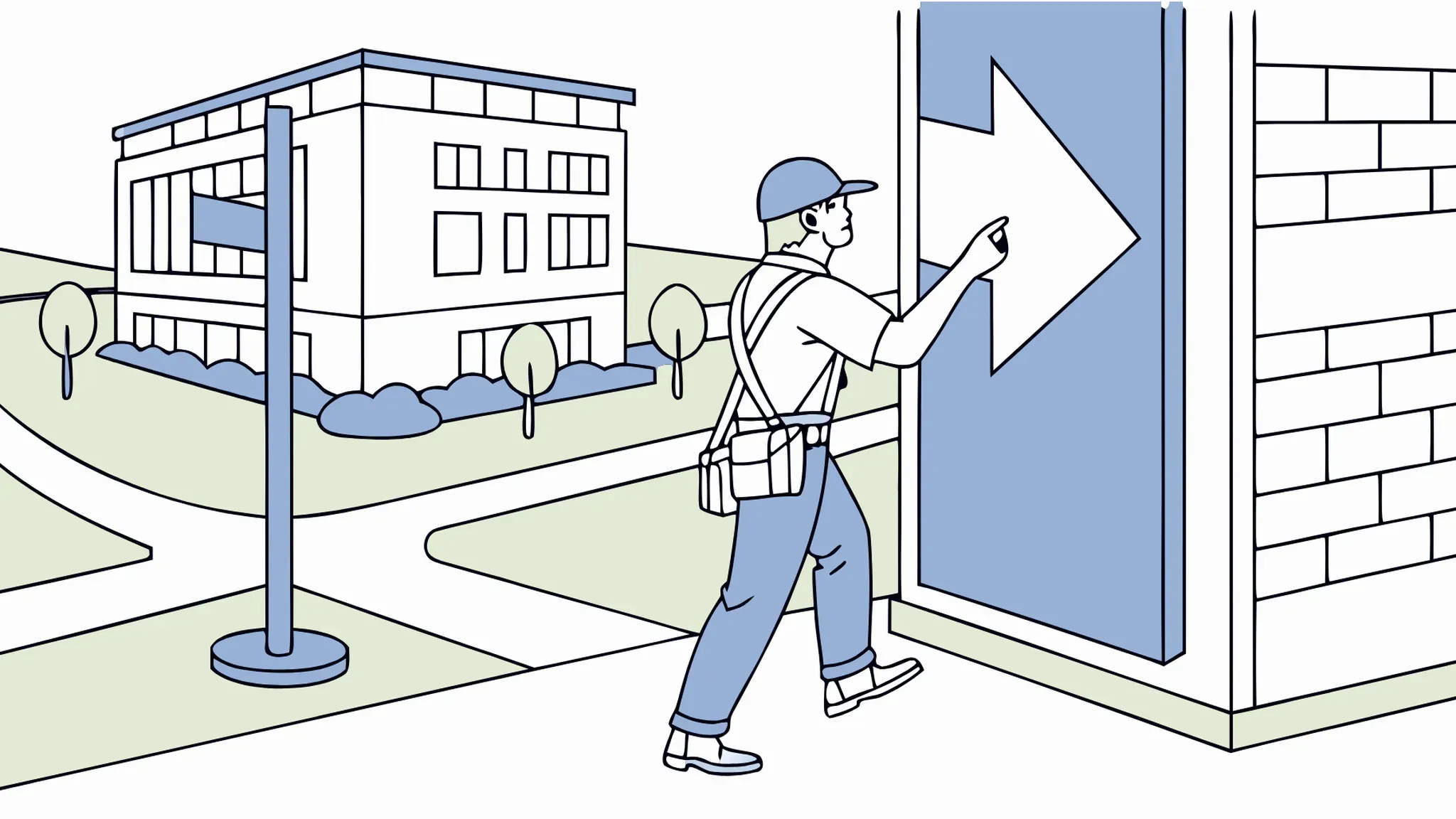
Wayfinding signage installation is the process of planning, surface prepping, and applying directional and identification graphics across a multi-building campus environment. For both corporate headquarters and education campuses, this includes wall-mounted directional signs, building identification graphics, floor decals, window films, and regulatory markers. Professional installation ensures these graphics remain durable, legible, and compliant with ADA standards for years.
Certified installers evaluate each surface type from smooth glass to porous brick and select the appropriate vinyl grade, adhesive system, and application method to match. A well-executed installation integrates the signage into the architecture seamlessly, reinforcing the brand while guiding every visitor to their destination.
Wayfinding signage does more than point people in the right direction. On a corporate campus, it shapes the first impression for clients, recruits, and partners who visit your headquarters. Clean, consistent signage communicates professionalism, organization, and attention to detail. On an education campus, it reduces student stress during the first weeks of a semester, helps families find their way during move-in days, and guides visitors to administrative offices, lecture halls, and event spaces. Both environments share a core requirement: the signage must be durable enough to withstand daily traffic and environmental exposure while remaining visually cohesive with the brand.
Beyond convenience, effective wayfinding supports safety. Emergency evacuation routes, fire assembly points, and exit signage must be clearly marked and compliant with local building codes. A comprehensive wayfinding signage installation plan accounts for these requirements from the start, reducing liability and ensuring that visitors and occupants can navigate safely in any situation.
From a branding perspective, wayfinding signage is a physical extension of your visual identity. Every sign, decal, and directional marker reinforces your logo, color palette, and typography. This consistency builds trust and recognition. When a corporate headquarters or university invests in a coordinated wayfinding system, it sends a clear message: this organization values clarity, quality, and the experience of everyone who steps onto its campus.
Ready to implement a cohesive wayfinding system on your campus? Request a consultation with AP Installations today.
Before installation begins, it helps to understand the four functional categories of wayfinding signage. Each type serves a specific purpose and may require different placement, materials, and surface preparation.
These signs name a location: building names, room numbers, department identifiers, and suite markers. They help visitors confirm they have arrived at the right place. In corporate settings, identification signs often incorporate the brand logo. On education campuses, they include building names like "Science Hall" or "Library."
Directional signs guide people toward a destination. They include wall-mounted directional panels, hanging signs at corridor intersections, and floor decals that lead visitors through a path. These signs typically use arrows and clear typography to communicate the route efficiently.
Informational signs provide context about a location or service. Examples include directory boards near elevators, hours-of-operation signs on building entrances, and digital kiosks that display real-time event schedules. These signs reduce the need for visitors to ask for help.
Regulatory signs communicate rules, warnings, and access restrictions. This category includes ADA-compliant accessible route markers, no-smoking signs, restricted area warnings, and fire safety evacuation maps. These signs are legally required in most jurisdictions and must meet specific mounting height and contrast standards.
Most campus wayfinding signage installation projects include all four types. A well-designed system layers them together so visitors can move from a parking lot to a specific office or classroom without stopping to ask directions.
Surface preparation is the most critical phase of any wayfinding signage installation. The adhesion and longevity of vinyl graphics depend almost entirely on how well the substrate is prepared. Corporate and education campuses feature a wide range of building materials, and each requires a specific approach.
Use the surface type as the starting point for the installation plan.
| Surface. | Primary risk. | Preparation focus. | Typical approach. |
|---|---|---|---|
| Concrete. | Porosity and trapped moisture. | Clean, test moisture, and allow full drying. | Primer or barrier film when approved. |
| Brick. | Uneven faces and mortar joints. | Remove dust, loose mortar, and biological growth. | Cast vinyl, heat forming, and careful placement. |
| Textured wall. | Incomplete contact and edge lift. | Evaluate texture, paint cure, and adhesion. | High-tack film or a smooth backing panel. |
| Glass or metal. | Oil, residue, or glossy finish. | Clean, degrease, and test a small area. | Purpose-fit film and approved surface prep. |
Concrete is a common substrate on both corporate and education campuses, especially for exterior walls, parking structures, and interior lobby columns. Concrete appears smooth but is actually porous at a microscopic level. Moisture trapped inside concrete can outgas over time, creating bubbles under vinyl graphics. Professional installers test concrete surfaces for moisture content before beginning any application.
If moisture levels exceed manufacturer specifications, a vapor-permeable primer or barrier film may be applied. The surface must also be cleaned of dirt, efflorescence, and any previous adhesive residue. A mild detergent solution followed by a clean water rinse is standard. Allow concrete to dry completely before application.
Brick presents one of the toughest challenges for wayfinding signage installation. The uneven texture and deep mortar joints make standard vinyl application difficult. Cast vinyl is the recommended material for brick because it can be heat-formed to conform to the texture of each individual brick face. The surface must be clean and free of loose mortar, dust, and biological growth like moss or mold. Pressure washing with low pressure is effective for exterior brick, followed by a drying period of 24 to 48 hours depending on weather conditions.
For interior brick feature walls, a tack cloth wipe-down removes dust from crevices. Installers may apply a primer to seal the porous surface and improve adhesion. On brick, the positioning is critical: graphics should be centered on the flat face of bricks rather than spanning mortar joints whenever possible.
Interior textured walls such as knockdown, orange peel, or sand finish require careful evaluation before installation. Heavy textures prevent vinyl from achieving full surface contact, leading to edge lifting and premature failure. For mildly textured walls, a high-tack adhesive vinyl or a textured-surface-specific film may work. For heavily textured surfaces, installers may recommend a smooth acrylic or aluminum backing panel mounted to the wall first, with the vinyl graphic applied to the panel.
This approach creates a professional-looking result while preserving the underlying wall texture. Painted walls present their own risk: fresh paint requires at least 30 days of curing before vinyl application. Low-quality or glossy paint may not provide sufficient adhesion, and peeling paint will take the vinyl graphic with it. Test adhesion in a small inconspicuous area before proceeding with the full installation.
Glass windows and metal panels are the simplest surfaces for wayfinding signage installation. Glass must be thoroughly cleaned with a lint-free cloth and glass cleaner to remove oils and residues. Perforated window film is often used for glass applications where one-way visibility is desired. Metal surfaces such as aluminum panels or steel columns should be degreased and lightly scuffed if they have a glossy powder-coated finish to improve mechanical adhesion. Avoid applying vinyl to surfaces that exceed 120 degrees Fahrenheit, as extreme heat softens the adhesive and reduces bond strength.
Planning a wayfinding signage installation for a multi-building campus involves coordination between facility managers, brand teams, and certified installers. Here is the standard process.
Walk every entry point, corridor intersection, elevator lobby, and destination location. Document current signage, identify gaps, and note surface types at each installation point. This audit becomes the master plan for the entire project.
Not all signs have equal importance. Primary signs direct visitors between buildings and major zones. Secondary signs guide them within buildings. Tertiary signs mark individual rooms and specific destinations. A clear hierarchy prevents visual clutter and helps visitors process information quickly.
Each installation point falls on a specific substrate. Match the vinyl grade, adhesive type, and protective laminate to the surface material and environmental exposure. Exterior signs require UV-resistant laminate. High-traffic interior areas benefit from anti-graffiti overlays. Floor graphics need anti-slip textured overlays.
A complete campus wayfinding signage installation for a large corporate or education campus typically takes months. Phase the work to minimize disruption. Start with building identification signs that orient visitors from the perimeter. Then install directional signs at major intersections. Finally, complete interior room-level signage. Phasing allows you to test the system and make adjustments before full rollout.
Coordination with campus operations is essential. Installations must work around academic calendars, corporate events, and facility schedules. A certified installer handles all of this logistics so your team can focus on daily operations.
Large campuses cannot shut down for signage installation. A phased rollout strategy ensures the project moves forward without interfering with classes, meetings, or daily operations.
Phase 1: Perimeter and entry points. Install building identification signs, parking guidance graphics, and main entrance markers. These signs orient visitors before they enter any building and create immediate brand impact.
Phase 2: Primary corridors and intersections. Install directional signage at major hallway crossings, elevator lobbies, and stairwell entrances. This phase establishes the internal navigation framework.
Phase 3: Building interiors and department zones. Install identification signs for departments, offices, classrooms, and common areas. Add informational directories and regulatory signs where required.
Phase 4: Floor graphics and fine-grain wayfinding. Install floor decals, room-level markers, and any remaining informational or regulatory signs. This final layer completes the navigation experience.
Each phase lasts one to three weeks depending on campus size. Between phases, facility managers can evaluate how visitors interact with the new signage and request adjustments before the next phase begins.
Wayfinding signage on corporate and education campuses must comply with the 2010 ADA Standards for Accessible Design. Key requirements include mounting heights, visual contrast, tactile elements, and Braille where applicable. Permanent room identification signs must include Grade 2 Braille and tactile characters with a minimum stroke width. Characters must contrast with the background surface to ensure legibility for people with low vision. Mounting height requirements specify that tactile characters be between 48 and 60 inches from the floor, measured from the baseline of the character. Installers must verify these dimensions on every sign during installation.
For directional and informational signs, ADA compliance focuses on readability and placement. Signs should not project into pedestrian pathways. Floor graphics should use contrasting colors and slip-resistant materials. Digital kiosks must meet touch-target size requirements and provide screen-reader compatibility. Working with a certified installer who understands these requirements saves time and reduces compliance risk.
Selecting an installation partner for a campus-wide wayfinding signage project requires more than comparing hourly rates. Look for these qualifications.
Certification. A 3M Preferred Installer certification indicates the company has undergone rigorous training and testing at 3M headquarters. This certification is held by only a small fraction of installers nationwide. It ensures the team understands material science, adhesive compatibility, and application techniques for challenging surfaces like brick and concrete.
Surface experience. Ask about specific experience with the substrates on your campus. An installer who has successfully applied vinyl to historic brick buildings, cast-in-place concrete, and textured interior walls brings practical knowledge that a general sign hanger does not.
Project scale. Campus projects involve multiple buildings, diverse surfaces, and phased scheduling. Confirm the installer has managed projects of similar scope and complexity. AP Installations brings over 17 years of experience executing large-scale campus graphics projects across the Pacific Northwest and nationwide.
Warranty coverage. Inquire about warranty protection. A certified installer can offer the 3M MCS Warranty, which provides up to 9 years of non-prorated coverage on vertical applications. This warranty protects your investment against material defects and premature failure.
References and portfolio. Review past campus projects similar to yours. AP Installations project portfolio includes work for transportation agencies, sports venues, retail environments, and institutional clients.
First impressions matter. When a visitor arrives at a corporate headquarters or university campus, the signage they encounter shapes their perception of the organization within seconds. Peeling decals, mismatched signage, or confusing directional markers create a negative impression that undermines the brand. High-quality wayfinding signage installation delivers the opposite effect. Clean, consistent, durable signage communicates that the organization values professionalism and cares about the visitor experience.
Research in environmental psychology supports this. Clear navigation reduces anxiety and allows visitors to focus on their purpose for visiting rather than worrying about getting lost. For corporate campuses hosting clients and candidates, this translates directly into more productive meetings and better recruitment outcomes. For universities, it means smoother orientation events, happier parents, and more confident new students navigating campus for the first time.
Brand reinforcement is another critical factor. Every directional sign, identification marker, and informational display is an opportunity to reinforce the brand identity. Corporate headquarters can use their brand colors and typography on every sign, creating a cohesive environment that reinforces the brand message at every touchpoint. Universities can extend campus visual identity into the built environment, creating a sense of place and belonging that strengthens institutional pride.
Wayfinding signage is a coordinated system of signs that work together to help people navigate a space. Regular signage typically serves one purpose, such as identifying a room, without connecting to a broader navigation strategy. Wayfinding systems include identification, directional, informational, and regulatory signs that form a complete navigation experience.
A full campus wayfinding signage installation for a medium-sized corporate or education campus with 20 to 40 buildings typically takes four to eight months when phased properly. The timeline depends on campus size, surface diversity, number of signs, and coordination with campus operations. Phased rollouts help facility teams maintain normal operations during installation.
Yes, but these surfaces require specialized materials and techniques. Cast vinyl can be heat-formed to conform to brick texture. Concrete surfaces must be tested for moisture content and cleaned thoroughly before application. A 3M Preferred Installer has the training and experience to prepare graphics for both brick and concrete substrates.
ADA requirements include mounting heights of 48 to 60 inches for tactile signs, Grade 2 Braille on permanent room identification, and high visual contrast between characters and background. Signs must not project into pedestrian pathways. Floor graphics require slip-resistant materials. Digital kiosks need accessible touch targets and screen-reader compatibility.
Costs vary based on campus size, number of signs, surface types, and material specifications. A comprehensive wayfinding signage installation for a multi-building campus represents a significant investment in brand infrastructure. Contact AP Installations for a project-specific quote based on your campus audit.
A professional wayfinding signage installation transforms how visitors, employees, and students experience your campus. From surface preparation on challenging substrates to phased rollout that respects your operational schedule, every step requires certified expertise. AP Installations brings over 17 years of experience as a 3M Preferred Installer, delivering durable, compliant, and brand-aligned wayfinding signage for corporate headquarters, universities, and institutional campuses across the Pacific Northwest and nationwide.
Contact AP Installations today to schedule a campus wayfinding signage consultation.