Blog
Office Wall Mural Company In Beaverton
Compare office wall mural companies in Beaverton by surface preparation, artwork coordination, installation quality, scheduling, and quote details.
Blog
Compare office wall mural companies in Beaverton by surface preparation, artwork coordination, installation quality, scheduling, and quote details.
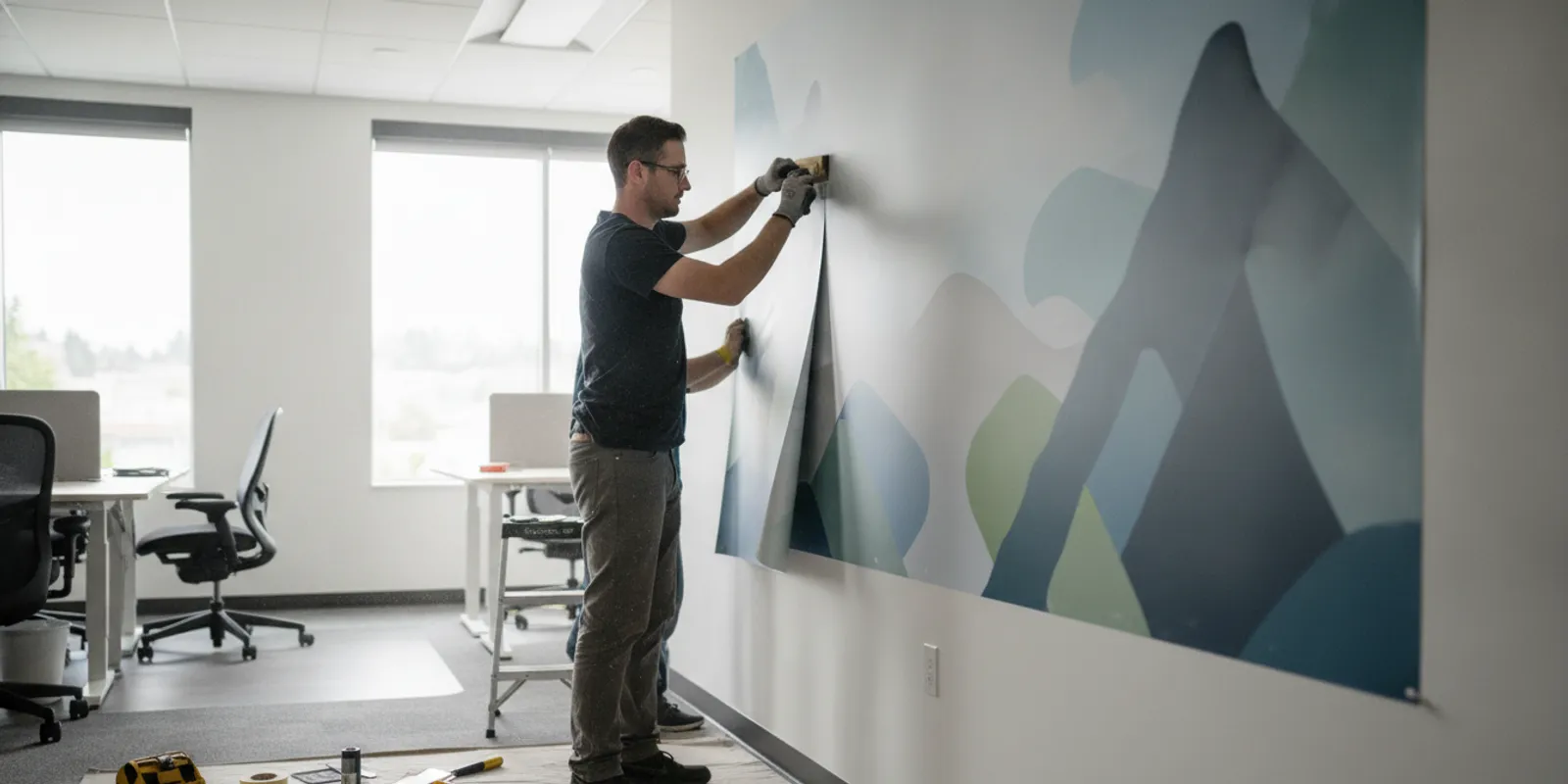
Choosing an office wall mural company in Beaverton involves more than selecting an attractive image. The right installation partner must understand the wall surface, coordinate with your print or design team, protect the workplace during installation, and apply the graphic with careful alignment and finish. A clear scope, site review, and documented approval process help your business move from concept to completed mural with fewer avoidable surprises.
Discuss your office mural installation
Begin with the job the mural needs to perform. An office wall graphic may create a focal point in reception, reinforce a company’s visual identity, help visitors understand a space, support an employee area, or bring a blank corridor into a more intentional environment. The purpose affects the wall location, image scale, material selection, finish, and installation plan.
Write a short project brief before requesting proposals. Include:
This information makes proposals easier to compare. It also prevents an important responsibility from being assumed rather than assigned. For example, a business may already have a designer and print vendor but need an experienced installation specialist. In that case, confirm who measures the wall, prepares the production file, prints the panels, ships the material, and performs the onsite application.
AP Installations focuses on commercial vinyl graphics installation and partners with print and design firms. Businesses can review the project gallery to understand the range of graphic installation work shown by the company. The goal is not simply to find a provider that can apply vinyl, but to find a team whose process fits the size, surface, and coordination needs of your mural.
The wall is part of the installation specification. A smooth, clean, sound surface generally provides a more predictable starting point than a wall with flaking paint, dust, moisture, deep texture, or previous adhesive. Share straight-on photos and close-ups of the wall before a quote is finalized. Photos can identify obvious questions, but they do not replace a site-specific assessment when the surface is uncertain.
Paint condition deserves particular attention. Painted drywall should be fully cured according to the paint manufacturer before vinyl is applied. The appropriate cure period depends on the product and the conditions in the room, so do not rely on a generic waiting period. If the wall was recently painted, tell the installer what product was used and when it was applied. An adhesion test on the actual surface may help the team evaluate the selected material before a large graphic is produced.
Texture can change the plan as well. A lightly textured wall may behave differently from smooth drywall. Pronounced texture, seams, patched sections, loose paint, and uneven transitions can affect adhesion and the appearance of the finished mural. If the wall needs repair, determine whether preparation is included in the installation scope or must be completed by another contractor before the crew arrives.
Also consider environmental conditions. A wall near a busy entry, break room, service area, or corridor may experience more contact than a wall in a private office. Temperature, humidity, sunlight, cleaning routines, and nearby equipment may influence the material and finish discussion. These factors do not produce one universal answer; they give the installer information needed to recommend an appropriate approach.
For additional context on the work involved, review AP Installations’ wall mural installation guide. A guide cannot assess your specific wall, but it can help your facilities or project team prepare useful questions before the site review.
There is no single best installation arrangement for every office mural. Some businesses have approved artwork and a trusted printer. Others need help coordinating measurement, production, delivery, and application. A small feature wall may have different risks from a mural that spans several rooms or continues around corners. Compare the approaches below against your schedule, internal skills, and tolerance for rework.
| Approach | Potential fit | Questions to resolve |
|---|---|---|
| Installer working with your print partner | Your artwork and production relationship are already established. | Who verifies measurements, specifies panels, manages delivery, and handles issues with the printed material? |
| Installer plus coordinated project support | Your team wants one partner to help align design, printing, delivery, and onsite work. | Which tasks are included, who approves proofs, and what changes affect the scope or schedule? |
| In-house or do-it-yourself application | A small, simple graphic and an appropriately prepared wall are available. | Who will manage alignment, seams, bubbles, trimming, surface preparation, and rework if the result is not acceptable? |
| Phased professional installation | The office has several rooms, locations, or operating constraints. | How will artwork versions, room labels, access windows, and inspection records stay consistent from phase to phase? |
Professional installation is especially worth discussing when the mural is large, includes multiple panels, spans corners, requires precise visual alignment, or will be seen by visitors and customers. It can also help a print shop or agency deliver a complex project without adding unfamiliar onsite work to its own schedule. AP Installations describes its broader vinyl installation and graphics solutions for businesses, brands, agencies, and print partners.
Artwork should be prepared for the real wall, not only reviewed on a computer screen. Measure the usable area and record the location of every obstruction. Note whether the image must continue across a corner, stop at trim, align with an architectural feature, or avoid a door swing. If the wall is divided into sections, decide how the image will transition at each break.
Before printing, establish an approval gate. The final review should cover dimensions, orientation, crop, image resolution, color expectations, panel breaks, seam locations, and any text or logos supplied by the client. A screen proof may not show every installation constraint, so invite the installer to flag practical issues before production. At the same time, assign responsibility for final content approval clearly. The installer should not be expected to approve a client’s brand message or artwork on the client’s behalf.
Ask the print partner how the graphic will be divided into panels and how those panels will be sequenced onsite. Panel planning affects seam placement, handling, alignment, and the time required in the room. Label files and panels consistently. For a project with more than one wall, use room names and wall identifiers rather than informal descriptions such as “the large wall.”
Keep a single record of the approved artwork version, measured dimensions, material specification, delivery date, access notes, and installation contact. If a design changes after measurement, send the revised file through the same approval process. A small untracked change can create a mismatch between the print run and the wall that was measured.
Businesses considering other commercial graphic applications can also review AP Installations’ guidance on window graphics types and materials and industrial wayfinding graphics. Those applications have different technical requirements, but they reinforce the same planning principle: the substrate, environment, message, and installation method should be considered together.
An interior office mural is not automatically the same as a public art project. However, if the graphic is visible from outside, installed in a shared public facility, or part of a broader property improvement, ask the building owner or facilities contact whether additional approvals apply. Confirm the responsibility before artwork is finalized.
The City of Beaverton’s official murals resource includes a mural toolkit described as a step-by-step guide for artists, businesses, and property owners. It is a useful local reference when a project has a public-facing or property-owner component. The page does not replace your building’s rules or a site-specific review, so confirm any required permissions with the appropriate property and facility contacts.
Installation planning should begin with access, not only with the desired completion date. Tell the provider about building hours, loading procedures, security, elevator restrictions, parking, equipment limits, and any areas that cannot be closed. In an occupied office, involve facilities, office management, information technology, and the people who use the room when their work may be affected.
Before the crew arrives, clear furniture and personal items from the work area if the project plan requires it. Make the full wall accessible and identify anything that cannot be moved. Protect nearby floors, furniture, and equipment as agreed. If the crew must work around desks, cabinets, monitors, or fixed fixtures, share that information in advance rather than treating it as an onsite discovery.
Ask how long the room will be unavailable, including preparation and cleanup rather than only the time spent applying vinyl. A large mural may require staging, panel handling, trimming, inspection, and a final cleanup. If the room hosts meetings or customer visits, select an installation window that leaves enough margin for a walkthrough before normal use resumes.
For a multi-room rollout, build a repeatable schedule. Give every room a label, maintain a current access list, and record the artwork version assigned to each wall. If the office has several locations, use the same reporting format for measurements, delivery, installation, exceptions, and completion photos. This helps the project team distinguish a true site condition from a simple labeling or file-version error.
Installation pricing depends on project details. A typical vinyl installation range is about $3 to $6 per square foot for materials plus labor, but that is a general reference rather than a guaranteed price for an office mural. Wall condition, access, graphic complexity, panel count, removal, travel, preparation, and project coordination can change the estimate.
Give the provider enough information to evaluate the work:
Then ask what the quote includes and excludes. Confirm whether it covers site review, surface preparation, installation labor, travel, removal, disposal, after-hours work, equipment, cleanup, and a return visit if one is needed. Ask how a change in measured dimensions or site conditions will be handled. A clear quote may cost more than a quick estimate, but it gives the project team a more useful basis for comparison.
AP Installations provides a graphic installation quote form for project details. You can also contact AP Installations with the wall information, photos, artwork status, and schedule questions that apply to your project.
Ask about the workflow, not only the finished photograph. A capable installation partner should explain how the team reviews the substrate, prepares the work area, handles panel alignment, manages corners and obstructions, and documents completion. The answer should be specific to your wall rather than a generic promise about quality.
Match the provider’s experience to the project’s scale. A small feature wall, a detailed mural with tight alignment needs, and a multi-floor office rollout do not present the same planning challenges. AP Installations identifies itself as a 3M Preferred Installer and a specialized commercial vinyl graphics installation company. You can read more about the role of that designation on the 3M certified installer information page.
Certification is one factor rather than a substitute for a project plan. If a provider discusses a 3M warranty, ask which materials and production methods are being proposed. Warranty eligibility depends on using the correct 3M Matched Component System, approved materials, documented production, proper installation, surface conditions, and exposure environment. Do not treat a certification statement as an automatic warranty for every mural.
For a broader view of AP Installations’ company information and capabilities, review the company overview. Use the information together with the site assessment, scope, quote, and references that apply to your specific project.
Set expectations for a final walkthrough before installation begins. Inspect the mural in normal room lighting and from typical viewing distances. Check overall placement, alignment at seams, edges, corners, transitions, and the treatment around fixtures. Compare the installed work with the approved proof and the written scope rather than relying only on a quick glance.
Record any item that needs attention and assign a next step. A useful closeout record can include the approved artwork version, material details, installation date, wall location, completion photos, care guidance, and any agreed follow-up. For a multi-room project, keep records organized by room and site so that facilities staff can find the correct information later.
Care instructions depend on the material and environment. Ask the supplier or installer which cleaning products and methods are appropriate. Avoid applying an unapproved cleaner, abrasive tool, or aggressive method to the graphic. If the office may be renovated or the mural may be replaced, retain the production file, measurements, and project notes for the next phase.
Before selecting an office wall mural company in Beaverton, confirm that your team can answer each question below:
Explore commercial graphics installation solutions
Send wall dimensions, straight-on and close-up photos, the building location, access requirements, desired timing, artwork status, material information if known, and details about existing graphics or surface concerns. Include the number of rooms or walls so the provider can assess whether the work should be phased.
It depends on the texture, selected material, wall condition, and expected use of the room. Share close-up photos and ask for a site assessment or adhesion test on the actual surface before production when the wall is uncertain. A smooth wall is not the only possible substrate, but texture should be part of the plan.
Not always. The wall should be clean, sound, and suitable for the selected material. Flaking paint, damage, heavy texture, or recent painting may require additional preparation or a change in timing. Follow the paint manufacturer’s cure guidance and confirm the surface condition with the installer.
Yes. Many businesses use a separate print partner and installation specialist. Confirm the file setup, measurements, material, panel sequence, delivery responsibilities, onsite access, and final approval process before the print run begins. Put those responsibilities in writing so a production question does not become an installation-day delay.
Timing varies with wall size, preparation, panel count, access, artwork readiness, and whether existing graphics must be removed. Ask for a schedule based on the actual site and include time for preparation, application, cleanup, and inspection. The room’s operating schedule should be part of that conversation.
Choosing the right office wall mural company in Beaverton starts with a realistic wall assessment, clear responsibilities, and a schedule that respects the workplace. When those details are agreed before production and installation, your team has a stronger foundation for a clean, well-documented finished graphic.