Facility Graphics for Food Manufacturing Plants
Facility graphics for food manufacturing plants have to do more than make a building look organized. In a food production environment, wall graphics, floor markings, wayfinding, safety decals, and branded environmental graphics need to support clean workflows, help teams move confidently, hold up under demanding conditions, and install without disrupting production more than necessary.
Planning a food production facility refresh or safety graphics rollout? Contact AP Installations to discuss a professionally installed graphics program for your plant.
For production directors and operations managers, the right graphics plan can turn a complex facility into a clearer, safer, easier-to-navigate workplace. The wrong plan can create peeling edges, confusing routes, inconsistent messaging, and avoidable downtime. That is why installation quality matters as much as the design itself.
AP Installations is a 3M Preferred Installer specializing in vinyl graphics installation for commercial and industrial environments. Since 2008, the team has installed wall graphics, window graphics, floor graphics, fleet graphics, banners, murals, and large-format brand environments for clients throughout the Pacific Northwest and across the country.
What are facility graphics for food manufacturing plants?
Facility graphics are professionally installed visual systems that help a plant communicate instructions, organize movement, reinforce safety procedures, identify zones, and present the company brand inside or outside the building. In food manufacturing, these graphics often need to serve operations, safety, compliance, visitor experience, sanitation, and brand standards at the same time.
Common facility graphics in food production environments include:
- Wall graphics for branded spaces, employee areas, visitor corridors, training zones, and production-adjacent areas
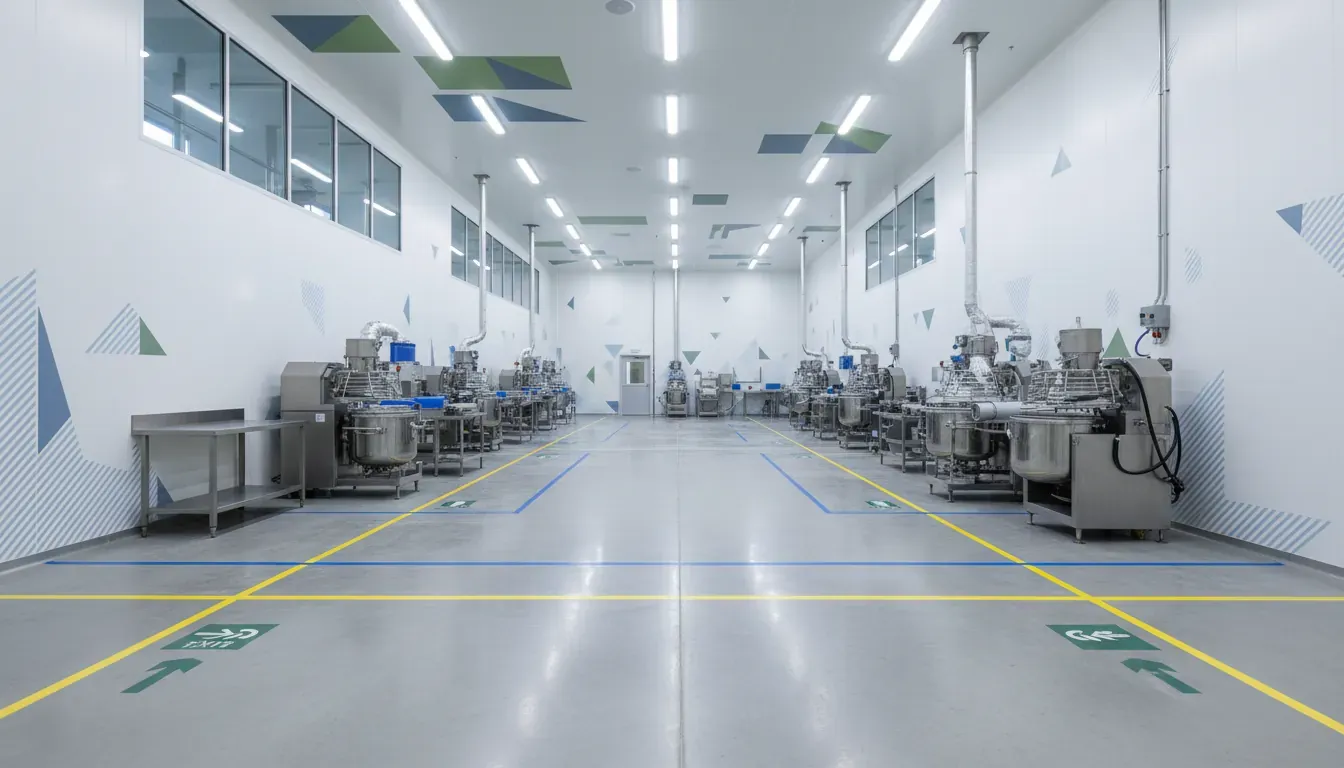
- Floor graphics for pedestrian routes, forklift zones, sanitation boundaries, staging areas, and directional cues
- Wayfinding graphics that help employees, vendors, auditors, and visitors move through the facility safely
- Safety markings that call attention to hazards, PPE requirements, restricted areas, equipment zones, and traffic patterns
- Large-format banners, murals, and environmental graphics that support hiring, culture, and brand storytelling
- Door, window, and surface graphics for room identification, privacy, food safety reminders, and operational communication
Unlike a standard office graphics package, a food manufacturing graphics program has to account for sanitation practices, traffic patterns, moisture, temperature changes, cleaning routines, surface conditions, and production schedules. The design may get attention, but the install determines whether the graphics perform in the real environment.
Why food production environments need a specialized graphics plan
Food manufacturing plants are high-accountability spaces. Teams are balancing throughput, quality, sanitation, worker safety, audits, vendor visits, and constant movement through the building. Graphics can help make that environment easier to manage when they are planned around how the facility actually operates.
A specialized plan matters because food facilities often include a mix of production floors, packaging areas, cold storage, dry storage, washdown zones, employee areas, loading docks, maintenance rooms, corridors, and front-of-house visitor spaces. Each area may require a different material choice, placement strategy, and installation window.
For example, a floor graphic in a pedestrian aisle has different performance requirements than a wall graphic in a visitor hallway. A wayfinding system near production may need to be clear at a glance, while a branded mural in a break area may be built to support recruiting, retention, and company culture. A safety marking near equipment must be placed for visibility and durability, not just aesthetics.
The best facility graphics programs start with the operating reality of the plant. Who needs to see the message? From what distance? During which shift? Under what lighting? Will forklifts, pallet jacks, carts, washdown routines, or high-touch use affect the surface? These questions shape the installation strategy.
How vinyl wall graphics support brand, culture, and communication
Vinyl wall graphics are often the most visible part of a facility graphics package. In food manufacturing plants, they can help transform corridors, lobbies, break rooms, training rooms, visitor paths, and production viewing areas into spaces that communicate professionalism and pride.
Wall graphics can be used to display brand values, food safety commitments, company history, employee recognition, product stories, mission statements, or large-format visual branding. When installed well, they make a facility feel intentional without adding bulky signage or permanent construction.
For plant leaders, this can matter in several practical ways:
- Visitor confidence: Customers, auditors, vendors, and partners see a clean, organized, branded environment.
- Employee alignment: Teams are reminded of safety priorities, production standards, and company values.
- Recruiting support: Facility tours and candidate visits feel more polished and memorable.
- Flexible updates: Vinyl graphics can often be refreshed more easily than painted murals or built signage.
AP Installations has experience with large-format wall graphics and murals across commercial environments. The team’s projects portfolio includes a Tillamook Factory large-format banner installation, a useful proof point for food and beverage brands looking for graphics installed with precision in high-visibility environments.
Where floor graphics and safety markings make the biggest impact
Floor graphics and safety markings are especially useful in facilities where movement patterns need to be clear. In food manufacturing, that might include forklift routes, pedestrian lanes, crosswalks, raw material receiving, finished goods staging, sanitation zones, restricted access points, emergency routes, and traffic intersections.
Professionally installed floor graphics can help reinforce plant procedures without requiring employees to stop and read a wall sign. Color, placement, shape, and repetition can guide behavior quickly. For example, a plant may use one color for pedestrian routes, another for equipment zones, and another for sanitation boundaries.
Safety graphics should never be treated as decoration. They need to be coordinated with the facility’s safety program, operational layout, and applicable requirements. For broader planning guidance, AP Installations’ warehouse safety graphics installation guide explains how floor and wall markings can support OSHA-conscious facility communication.
Durability is the deciding factor. Food production plants often include heavy foot traffic, carts, pallet jacks, cleaning routines, and temperature variation. Material selection, surface preparation, edge finishing, and placement all influence whether a floor graphic stays readable or becomes a maintenance problem.
How wayfinding graphics reduce confusion inside complex plants
Large food manufacturing facilities can be difficult to navigate, especially for new hires, vendors, service technicians, auditors, corporate visitors, and temporary staff. Wayfinding graphics help reduce confusion by making routes, rooms, departments, and access levels easier to understand.
A practical wayfinding system may include directional arrows, department identifiers, zone colors, room labels, dock numbers, visitor path graphics, PPE reminders, and restricted area notices. The system should be simple enough to understand quickly and consistent enough to work across the entire facility.
Wayfinding is also a safety tool. If visitors know where to walk, where to check in, which areas require escort, and which zones are off limits, plant teams spend less time correcting movement and more time focusing on production. For more detail on accessible navigation principles, see AP Installations’ guide to ADA compliant wayfinding signage.
For multi-site food manufacturers, consistency becomes even more important. A standardized graphics system can help employees move between facilities with less friction. It can also help operations leaders update signage more efficiently when workflows, equipment layouts, or safety procedures change.
What should operations managers consider before installation?
Before ordering or installing facility graphics, operations managers should align the graphics plan with plant conditions and production needs. A strong installation partner will ask about the facility, not just the artwork.
Key planning considerations include:
- Surface condition: Painted block, sealed concrete, stainless panels, drywall, glass, and textured surfaces may require different preparation.
- Cleaning routines: Washdown areas, chemical exposure, scrubbing, and sanitation schedules can affect material and placement decisions.
- Temperature and humidity: Cold storage, warm production areas, and seasonal changes can influence adhesion and timing.
- Traffic load: Pedestrians, carts, pallet jacks, forklifts, and equipment movement all affect graphic durability.
- Access requirements: Some areas may require off-hours work, escorts, PPE, lifts, or coordination with production supervisors.
- Audit visibility: Safety, hygiene, access, and wayfinding messages should be placed where they support real behavior.
- Future updates: Graphics should be planned so changes to lines, products, zones, or procedures can be refreshed cleanly.
If you are coordinating a graphics rollout across production, warehouse, and visitor areas, request a project conversation with AP Installations before artwork is finalized.
Early coordination helps prevent common problems, such as graphics designed for the wrong surface, floor markings placed where they will wear quickly, or installation scheduled during a production window that creates unnecessary disruption.
Why 3M Preferred Installer status matters for food facility graphics
Graphics in a food manufacturing plant are a brand investment and an operational tool. They need to be installed by a team that understands surface preparation, material behavior, temperature conditions, edge details, alignment, finishing, and project sequencing.
AP Installations is a 3M Preferred Installer, a credential that reflects hands-on training and installation standards for 3M materials. For food manufacturing teams, that matters because poor installation can lead to bubbles, lifting edges, misalignment, premature wear, and avoidable replacement costs.
Certified installation also supports better project risk management. A plant may be investing in a large wall mural, multi-zone wayfinding package, or facility-wide floor marking program. The larger and more visible the project, the more important it becomes to protect the finished result with experienced installation.
AP Installations also brings a pure-play installation model. The company focuses on professional application and installation of vinyl graphics, often partnering with design firms, print shops, agencies, and internal brand teams. That makes AP Installations a fit for organizations that already have artwork or print partners and need a dependable team to execute in the field.
How to minimize disruption during a plant graphics rollout
Downtime is one of the biggest concerns for production directors. Facility graphics should improve the plant, not interfere with production longer than necessary. A good installation plan accounts for access, shift schedules, sanitation windows, equipment movement, safety requirements, and areas that cannot be taken offline during normal operations.
AP Installations’ service delivery model includes site assessment, timeline planning, coordination with client operations, installation during off-hours when requested, and post-installation inspection. For food manufacturing plants, that kind of sequencing can be the difference between a smooth rollout and a project that creates avoidable friction.
Ways to reduce disruption include:
- Grouping installation areas by production schedule or sanitation window
- Completing visitor-facing or administrative graphics separately from production floor graphics
- Confirming access, PPE, escorts, lifts, and staging needs before the crew arrives
- Prioritizing high-traffic safety and wayfinding graphics when downtime is limited
- Using clear project communication so supervisors know which areas are affected and when
For nationwide or multi-location programs, planning also needs to cover consistency. Brand standards, material specifications, install documentation, and quality checks should travel from location to location so the program looks and performs the same way.
Facility graphics examples for food and beverage brands
Every food manufacturing plant is different, but several graphics applications tend to deliver strong value for food and beverage teams:
- Visitor corridors: Brand storytelling, product history, values, awards, and route guidance for plant tours.
- Employee entrances: Safety commitments, PPE reminders, shift communication, and culture graphics.
- Production-adjacent walls: Department identifiers, hygiene reminders, zone information, and process communication.
- Warehouse and shipping areas: Floor lanes, dock identifiers, pallet staging zones, and traffic separation.
- Break rooms and training areas: Employee recognition, mission statements, onboarding visuals, and safety reminders.
- Retail or tour spaces: Large-format branded graphics that connect customers and visitors to the product story.
The Tillamook Factory example on AP Installations’ projects page shows how large-format graphics can support a recognizable food brand in a high-visibility environment. That same installation discipline can be applied to less public but equally important areas inside food production and manufacturing facilities.
How to start a facility graphics project
The best time to involve an installer is before artwork and production are final. This gives the team time to review surfaces, access, placement, material suitability, and schedule requirements. It also helps designers and print partners produce graphics that are easier to install correctly.
A practical starting process looks like this:
- Define the goal: Safety communication, wayfinding, brand environment, visitor experience, employee engagement, or a full facility refresh.
- Map the locations: Identify walls, floors, doors, glass, corridors, docks, production-adjacent spaces, and visitor paths.
- Confirm operating constraints: Shift schedules, cleaning routines, access limits, food safety requirements, and production windows.
- Review materials and surfaces: Match vinyl, laminates, and adhesives to the environment and expected wear.
- Sequence the rollout: Plan installation by area, priority, and disruption level.
- Inspect and document: Complete a final walk-through and keep records for future updates or multi-site consistency.
Ready to plan facility graphics for food manufacturing plants? Contact AP Installations for certified installation support in the Pacific Northwest or for nationwide project rollouts.
Clearer facilities start with professional installation
Facility graphics can help food manufacturing plants communicate clearly, move people safely, reinforce compliance priorities, and create a stronger brand environment. But the long-term value depends on more than design. It depends on choosing the right materials, preparing surfaces correctly, scheduling around production realities, and installing with precision.
AP Installations brings 3M Preferred Installer expertise, nationwide capabilities, and proven experience with wall graphics, floor graphics, wayfinding, large-format banners, and branded environments. For production directors and operations managers planning a facility refresh, safety graphics update, or multi-site rollout, that installation focus helps protect the finished result from day one.